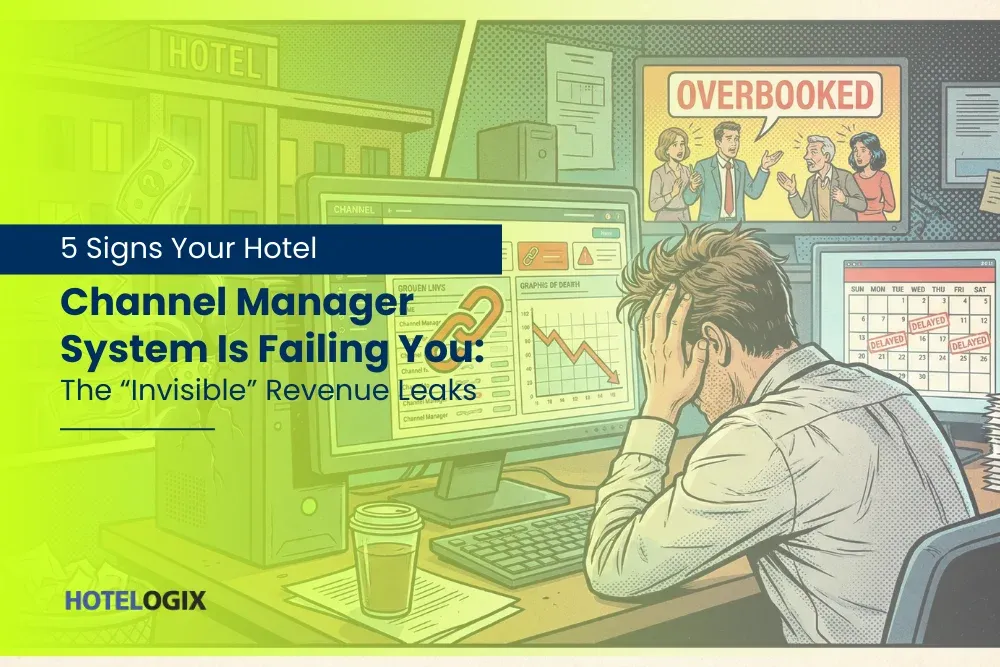

On the surface, everything looks fine. Rooms are selling, OTAs are connected, and your hotel channel manager shows no obvious errors. Yet results don’t really move. ADR stays flat, peak demand doesn’t convert into higher revenue, and your team keeps working harder just to maintain the same performance. Nothing feels broken, but nothing is improving either.
That’s because most revenue leaks don’t come from demand gaps; they come from small system frictions hotels rarely notice. Delayed rate updates, partial syncs, and manual workarounds quietly add up. With the hotel channel management market valued at USD 811 million in 2024 and expected to reach USD 1,817 million by 2034, the difference between “connected” and well-connected systems matters more than ever.
In this guide, we’ll break down five early signs your hotel channel manager system may be holding you back and why most hotels miss them.
TL;DR
- Most channel manager issues are invisible and surface as slow ADR growth, missed revenue spikes, and growing manual work.
- Rate delays, inventory mismatches, and overbookings are signs your system sync isn’t truly real-time.
- Manual fixes and dashboard discrepancies lead to operational inefficiencies and guest dissatisfaction.
- An integrated PMS with a built-in channel manager, like Hotelogix, helps eliminate these leaks by syncing rates, inventory, and operations in real time.
Why Hotel Channel Manager Issues Are Hard to Spot
Most channel manager problems don’t show up as red flags. There are no error messages, no system crashes; instead, teams quietly adapt.
- Front desk staff double-check availability “just in case”
- Revenue teams manually tweak rates during high-demand days
- Operations rely on spreadsheets alongside software
The revenue impact also feels gradual, not dramatic. You don’t lose all bookings overnight; you lose bookings over time.
Here’s how these issues usually surface in daily hotel operations.
Sign #1 – Rate Updates Don’t Reflect Instantly Across Channels
On the surface, rates look updated. But by the time they appear across OTAs, the demand spike has already passed. These delays are easy to overlook because nothing disrupts revenue; only underperforms.
When rate changes don’t move in real time, your hotel loses the chance to capture higher ADR during peak demand, and OTA visibility can quietly suffer.
This lag doesn’t feel urgent until you compare expected vs actual revenue.
Sign #2 – Inventory Needs Frequent Manual Corrections
If your team regularly double-checks availability or maintains backup spreadsheets, the system isn’t doing its full job. Manual effort often creeps in quietly, framed as “extra caution.”
In reality, this is usually a sign of weak or delayed sync between systems. As more channels are added, these workarounds don’t scale; they slow teams down and increase error risk.
You’ll notice this when:
- Staff cross-checks OTA extranets daily
- Inventory updates happen “just to be safe”
- Manual fixes become part of routine operations
Manual control feels reassuring, but it often hides lost occupancy potential.
Hotels using properly connected channel manager systems often see occupancy growth of 10% or more, depending on property size and channel mix. Manual corrections quietly block that upside.
Sign #3 – Overbookings or Stop-Sells Happen Despite a Channel Manager
Overbookings don’t always mean a missing channel manager; they often point to partial sync. Cancellations, modifications, or stop-sells don’t reflect everywhere at the same time.
These gaps surface most during high-occupancy days, when systems are under pressure and timing matters most.
Common triggers include:
- Last-minute cancellations are not updating across all channels
- Stop-sells applied in one system but missed elsewhere
- One-way sync instead of true two-way updates
The cost isn’t just operational. It shows up in guest dissatisfaction, refunds, and reputation impact.
Sign #4 – PMS and Channel Manager Tell Different Stories
Your PMS shows one set of numbers, while your channel manager shows another. Pickup, revenue, or availability doesn’t quite match, and teams spend time reconciling reports instead of acting on them.
This usually means your hotel PMS and channel manager aren’t truly in sync. Small update delays create data gaps that grow during busy periods and slow down pricing and distribution decisions.
This typically shows up as:
- PMS and channel manager reports are not matching
- Teams are unsure which dashboard to trust
- Decisions are getting delayed or second-guessed
Seeing these issues usually points to a bigger system gap. When a hotel’s PMS and channel manager don’t truly work as one, delays, mismatches, and manual fixes become part of daily operations.
Sign #5 – Your Team Spends More Time Managing Systems Than Selling Rooms
This is the most human sign and the most overlooked. When staff spend peak hours switching between tools, fixing sync issues, or reconciling data, guest-facing opportunities get missed.
Over time, this leads to slower responses, fewer upsells, and staff frustration, especially during high-occupancy periods.
You’ll feel this when:
- Teams juggle multiple dashboards per booking
- Manual fixes peak during busy hours
- Staff focus shifts from guests to systems
When systems demand more attention than guests, revenue growth quietly stalls.
What These Signs Mean for Hotel Revenue in 2026
- Slower rate reactions = lost ADR
- Inventory errors = lost trust
- Manual work = higher operational cost
The global hotel channel manager market itself is forecasted to grow from USD 0.68 billion in 2026 to USD 1.35 billion by 2035, reinforcing one reality: distribution tech is no longer optional, but how well it’s connected makes the difference.
How an Integrated PMS + Channel Manager Helps Eliminate These Gaps
This is where an all-in-one PMS with a built-in hotel channel manager makes a real difference. Platforms like Hotelogix are designed to remove these everyday gaps by connecting inventory, rates, reservations, and on-ground operations into one continuous flow.
How Hotelogix helps in practice:
- Channel Manager – Real-time rate and inventory sync across OTAs
- PMS Integration – One source of truth for reservations and availability
- Web Booking Engine – Direct bookings reflect live inventory instantly
- Front Desk, Housekeeping & POS – Unified operations reduce manual fixes
- Analytics & Reporting – Clear visibility across channels and performance
By bringing systems together instead of managing around them, Hotelogix helps hotels move faster, reduce revenue leakage, and focus more on selling rooms, not fixing systems.
FAQs Related to Invisible Revenue Leaks Caused by a Weak Hotel Channel Manager
Q1. What are common signs that a hotel channel manager is failing?
A: Frequent manual corrections, delayed rate updates, overbookings, and mismatched reports between PMS and channel manager are the most common warning signs.
Q2. How does a slow channel manager affect hotel revenue?
A: Slow updates miss peak-demand pricing windows, lower ADR, and reduce OTA visibility, all without obvious system errors.
Q3. Can a hotel channel manager cause overbookings?
A: Yes, if it relies on partial or one-way sync. Real-time two-way synchronization is critical to prevent inventory mismatches.
Q4. What’s the difference between PMS sync and real-time sync?
A: Basic PMS sync updates periodically. Real-time sync reflects every booking, cancellation, or rate change instantly across systems.
Q5. When should a hotel upgrade its channel manager system?
A: If teams rely on manual workarounds, reports don’t match, or overbookings persist, it’s time to reassess.
Q6. Is an all-in-one PMS and channel manager better for small hotels?
A: Yes. Fewer tools mean fewer gaps, lower training effort, and better control for lean teams.
Conclusion
These signs are more common than most hotels admit, and they’re fixable.
The first step isn’t replacing tools overnight. It’s recognizing where friction exists and how much revenue it quietly costs. As distribution grows more dynamic, visibility and speed matter more than ever.
In 2026, hotel performance depends less on how many tools you use and more on how well they work together. If you’re ready to reduce system friction and regain control across channels, book a free demo today and see how Hotelogix can help your hotel run smoother, sell smarter, and grow with confidence.