
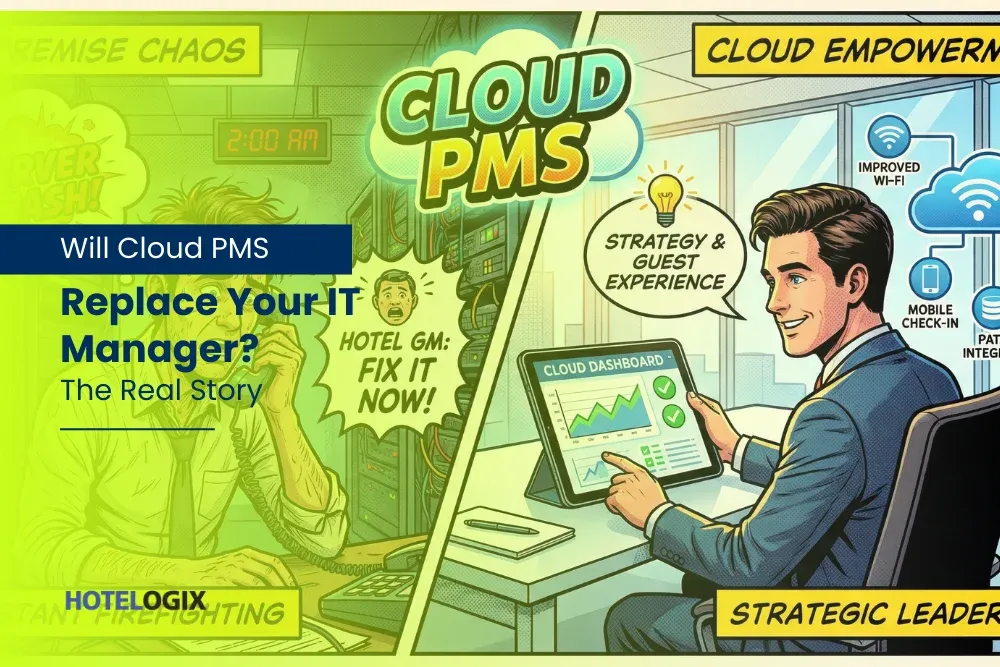

Raghav, IT manager at a 90-room hotel in Bengaluru, used to sleep with his phone beside him. Server crashes on Saturday nights, POS sync failures during check-out, and panic calls from the front desk were his norm — and the blame always landed on him.
So when his GM announced a move to cloud PMS, Raghav panicked. “If the system runs itself, what will I do?”
After the migration, things changed fast. Nightly updates ran automatically, outages fell, and Raghav stopped getting 2 AM calls. Freed from fire-fighting, he improved Wi-Fi, fixed long-standing integration bugs, and led a guest-tech rollout.
Key Takeaways
- Cloud reduces firefighting: With no servers to rescue, IT managers finally get breathing room instead of burnout.
- IT becomes more valued: Hotels that moved to the cloud ended up relying more on their IT managers — not less.
- Less blame, more respect: Fewer outages mean fewer angry calls, helping IT teams feel appreciated instead of blamed.
- Work shifts to meaningful tasks: Instead of patching servers, IT can focus on WiFi quality, clean integrations, and smoother guest experiences.
- Cloud brings peace of mind: Automatic updates and reliable uptime remove stress, letting IT do its job with confidence.
Why Do IT Managers Fear Cloud PMS?
The fear is real — new tech can feel like a threat to a role built around keeping things running. A recent study shows 89% of workers worry about new technologies like AI impacting their job security. It’s normal to wonder whether cloud PMS reduces the need for IT.
But the truth is the opposite: cloud removes repetitive, low-value maintenance, not IT leadership. When servers, backups, patches, and recovery shift to the vendor, IT finally moves from firefighting to building the hotel’s digital reliability.
What Actually Changes for IT After Cloud Migration?
Cloud shifts the infrastructure burden to the vendor: hosting, backups, patches, failover, and much of the maintenance are handled off-site. That reduces emergency firefighting and frees IT to focus on higher-impact work.
Industry context shows this is a real shift: the hotel technology market is growing rapidly, and 64.7% of PMS deployments were cloud-based in 2024, with cloud adoption expanding strongly. Hotels aren’t choosing cloud just for convenience — they want reliability and lower operational risk.
Bottom line: Cloud cuts maintenance — but it amplifies strategic IT work.
How does the IT role evolve?
When routine server work disappears, IT time moves to areas that directly improve operations and guest experience:
- Cybersecurity & compliance: Policies, access control, incident response.
- Integration management: Ensuring PMS, POS, channel managers, locks, and payments talk cleanly.
- Staff enablement: Training, quick troubleshooting, process design.
- Technology roadmap: Wi-Fi upgrades, analytics dashboards, guest tech rollouts.
This is why hotels that moved to the cloud ended up relying more on their IT manager — not less.
The Most Overlooked Benefit: Reduced Blame
Ask any hotel IT manager what drains them the most—and they’ll rarely mention workload. They’ll mention blame.
On-premise setups make IT the automatic target during outages, slowdowns, or technical failures. Even when the root cause is hardware age, vendor issues, or power fluctuations, IT carries the reputation hit.
Cloud PMS changes this dynamic entirely. With auto-updates, redundant hosting, 99.9% uptime, and no server room to maintain, the failure points shrink dramatically. That means:
- Fewer angry calls
- Fewer late-night emergencies
- Less stress
- Better relationships with operations
For many IT managers, this is the single biggest emotional relief after moving to the cloud.
How Cloud PMS Improves Daily Hotel Operations
When IT is no longer stuck fixing server issues, the whole hotel feels the impact:
- Faster WiFi improvements
- Better integration stability
- Reduced downtime
- Smoother front desk workflows
- Improved guest experience through tech reliability
- Faster rollout of new tools (payments, POS, mobile apps)
Cloud doesn’t take IT out of the picture—it lets IT elevate the entire operation.
How Hotelogix Supports IT Managers in This Transition
Here’s how Hotelogix empowers IT managers:
- API-first architecture for smooth integrations across PMS, POS, channel managers, payments, and accounting
- Automatic updates with no downtime or manual intervention needed
- 99.9% uptime backed by a secure and solid cloud infrastructure
- Centralized access control with role-based permissions and audit trails
- Real-time performance insights for operational visibility
- Smooth multi-property management for groups and chains
- Secure hosting environment with enterprise-level protection
This ensures IT teams can focus on building better digital experiences instead of maintaining hardware.
Many IT managers share a similar transformation after adopting Hotelogix: “With Hotelogix, I finally stopped fixing things and started improving things.” — IT Manager, 120-room property
FAQs
Q1. Will IT managers lose their jobs with cloud PMS?
A: No. The role evolves to focus on cybersecurity, integrations, analytics, and digital reliability.
Q2. What does IT manage in cloud-based hotels?
A: They oversee access control, system integrations, staff training, security compliance, and tech strategy.
Q3. Is cloud PMS secure enough?
A: Yes. Cloud systems provide enterprise-level security, automatic patches, encrypted data storage, and high uptime.
Q4. How long does IT take to adapt to cloud PMS?
A: Most IT teams feel confident within a few weeks and fully transition to strategic tasks within 3–6 months.
Q5. Can small hotels operate without full-time IT?
A: Some can, but eliminating IT is risky. Cloud reduces workload—but tasks like integrations, WiFi, hardware, and staff support still need oversight.
Is IT Still Essential in a Cloud-First Hotel?
Cloud PMS doesn’t take IT away — it gives IT the space to add real value. If you’re an IT manager worried about job security, consider cloud migration as an upgrade to your role: fewer midnight calls, more influence over strategy, and clearer impact on guest experience.
As Raghav said, “Cloud didn’t make me less important. It finally gave me room to do my job.”
If you want to see how cloud PMS can free your IT team and strengthen your hotel’s digital operations, book a quick consultation with our team.