
Revenue has become one of the biggest pressure points for today’s hotels. With demand patterns shifting quickly and distribution becoming more complex, pricing decisions now need to be faster, smarter, and data-backed. It’s why the global Revenue Management System (RMS) market touched USD 10.50 billion in 2024 and continues to grow rapidly as hotels embrace automation and intelligent forecasting.
In fact, industry research shows the RMS market is projected to reach USD 29.43 billion by 2031, highlighting how revenue optimization has become a core part of hotel operations, not just a strategy for large chains.
In this guide, we’ll break down the essential features every hotel needs in an RMS in 2026, how these systems work, and how Hotelogix supports smarter revenue decisions with integrated tools built for modern hospitality.
Key Takeaways
- Smarter Forecasting: Modern RMS platforms use AI and ML to improve demand prediction and pricing accuracy.
- Real-Time Pricing: Automated rate updates help hotels stay competitive without constant manual work.
- Integrated Decisions: When RMS connects to your PMS and channel manager, pricing and availability stay perfectly aligned.
- Better Distribution Control: Strong RMS tools help maintain rate parity and optimize your OTA strategy.
- Higher Profitability: Hotels using data-backed pricing see stronger ADR, RevPAR, and occupancy trends.
- Hotelogix Advantage: Built-in tools and smooth integrations help hotels automate revenue decisions with ease.
What is Hotel Revenue Management Software, and how does it work?
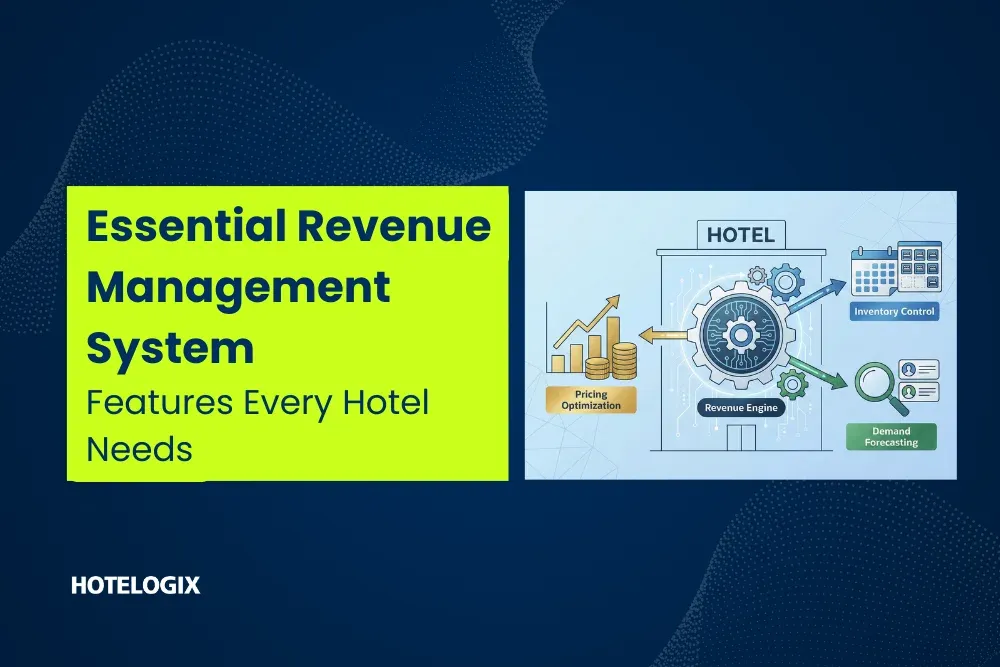
A Revenue Management System (RMS) is software that helps hotels forecast demand, automate pricing, and optimize revenue across seasons, channels, and room types. It uses data, market trends, and competitor insights to recommend the right price at the right time.
An RMS works by collecting data from multiple sources — booking history, market trends, events, competitor pricing, and occupancy patterns — and analyzing them using AI-driven algorithms. It then recommends the ideal pricing strategy and pushes these updates across your booking channels automatically.
How it works, step by step:
- Data Collection: Historical bookings, market shifts, competitor rates, demand indicators.
- AI & ML Analysis: Predicts demand more accurately, adjusting for seasonality, events, and booking pace.
- Automation: Updates rates across OTAs, your website, and your PMS in real time.
- Continuous Optimization: Learns from booking patterns to improve future pricing.
The growing integration of AI and machine learning is significantly improving forecasting accuracy and dynamic pricing decisions — one reason the RMS market is expanding at an 8.7% CAGR from 2024 to 2031.
Key Functions of a Modern Revenue Management System
A strong RMS should be able to:
- Forecast Demand: Predict booking trends based on historical and market data.
- Optimize Pricing: Adjust room rates dynamically using real-time insights.
- Manage Inventory: Allocate the right rooms to the right channels at the right time.
- Analyze Competitors: Monitor competitor pricing to stay competitive.
- Maintain Rate Parity: Ensure uniform rates across OTAs and direct channels.
- Generate Reports: Provide insights into ADR, RevPAR, pickup, and pace patterns.
- Segment Guests: Analyze demand from different guest types and markets.
Challenges Hotels Face Without an RMS
Hotels that don’t use an RMS often struggle with revenue accuracy, distribution consistency, and timely decision-making. Here are the most common challenges:
Inaccurate Pricing: Rates are often set based on guesswork or outdated data, leading to underpricing in high demand and overpricing in slow periods.
Poor Forecasting Visibility: Without automated demand analysis, hotels can’t predict occupancy shifts, seasonal dips, or event-driven spikes accurately.
Slow Reaction to Market Changes: Manual teams can’t adjust rates quickly enough when competitors change prices or demand surges suddenly.
Rate Parity Issues: Lack of automated updates across OTAs often results in mismatched rates, overbookings, and visibility penalties.
High Operational Workload: Staff spend hours updating rates, monitoring channels, and fixing inconsistencies — slowing down decision-making.
Revenue Leakage: Missed upsell opportunities, delayed price adjustments, and suboptimal inventory allocation reduce ADR and RevPAR potential.
Why Hotels Need an RMS
Here are the biggest advantages:
✓ Higher Revenue: AI-powered pricing ensures every room is sold at its optimal rate.
✓ Better Forecasting: More accurate predictions improve planning and inventory allocation.
✓ Reduced Manual Work: Automates price updates across OTAs and your booking engine.
✓ Improved Consistency: Rate parity is easier to maintain when everything updates in real time.
✓ Faster Market Response: Instant adjustments during events, high demand, or competitor shifts.
✓ Stronger Direct Booking Strategy: Revenue insights help you plan promotions and packages.
✓ Better Visibility: Reports highlight which room types or channels perform best.
✓ More Profit Per Booking: Improved ADR and RevPAR through smarter pricing.
Essential Revenue Management System Features to Look For
Hotelogix supports revenue-focused workflows by keeping data consistent across your PMS, OTAs, booking engine, and guest-facing channels.
RMS vs PMS vs Channel Manager: What’s the Difference?
RMS: Optimizes pricing and revenue using forecasting and automation.
PMS: Handles daily operations, reservations, check-ins, housekeeping, billing, POS, and more.
Channel Manager: Distributes rates & availability across OTAs in real time.
How they work together: RMS sets the right price → Channel Manager pushes it to OTAs → PMS receives bookings and updates inventory → Data flows back to RMS for better forecasting.
Hotelogix unifies PMS + Channel Manager + Booking Engine, making revenue decisions easier and more accurate.
Top 3 RMS Platforms for Hotels
Here are some highly trusted RMS platforms that integrate well with PMS systems:
1. RateGain
Known for pricing intelligence, competitor monitoring, and strong forecasting capabilities.
2. Atomize
AI-driven pricing engine designed for real-time rate updates and automation-friendly workflows.
3. Duetto
Popular among larger hotels, it provides advanced segmentation and revenue insights.
These tools integrate with PMS solutions like Hotelogix to help hotels build a flexible, data-backed revenue ecosystem.
How Hotelogix Supports Revenue Decisions
Key Highlights:
- Unified PMS: Centralized control for front desk, housekeeping, reservations, and daily hotel operations.
- Real-Time OTA Sync: Automatic rate and availability updates across all channels.
- Analytics & Reporting: Clear visibility into ADR, RevPAR, booking trends, and channel performance.
- RMS Integrations: Smooth connectivity with leading revenue management tools for automated pricing.
- Team Efficiency: Smoother coordination between front desk, housekeeping, and revenue teams.
- Multi-Property Support: Group-level dashboards for consistent pricing and performance monitoring.
Hotelogix brings your revenue tools and hotel operations together, helping you make smarter, data-backed decisions with ease.
FAQs
Q1-What is the most important feature of a Revenue Management System?
A-Accurate forecasting and dynamic pricing are the most important features, as they directly impact ADR, RevPAR, and revenue growth. Modern RMS tools use AI and ML to enhance accuracy.
Q2-Can small hotels use an RMS?
A-Yes. Even a 20–30-room hotel benefits from automated pricing, especially if bookings fluctuate or depend heavily on OTAs.
Q3-How does an RMS improve revenue?
A-By analyzing demand, market trends, and competitor rates, an RMS helps hotels price rooms optimally, improving occupancy and profitability.
Q4-Does an RMS replace a PMS?
A-No — an RMS works with your PMS. The PMS manages operations; the RMS manages pricing.
Q5-Is AI important in revenue management?
A-Absolutely. AI-driven RMS tools can detect demand patterns faster and more accurately than manual methods.
Q6-Does Hotelogix include revenue management features?
A-Hotelogix integrates easily with leading RMS providers and offers built-in reporting, OTA sync, and rate controls to support revenue decisions.
Final Takeaway
Revenue optimization is no longer optional for modern hotels; it’s a competitive necessity. With AI-driven forecasting, dynamic pricing, and automated distribution, a strong RMS helps hotels unlock better ADR, occupancy, and profitability. And with Hotelogix, you get a connected PMS ecosystem that supports real-time pricing decisions, easy OTA management, and clear insights, all designed to help you grow with confidence.
Ready to simplify revenue management? Book a demo today to learn how Hotelogix helps hotels make smarter, data-driven decisions every day.