
Running a hotel smoothly is not easy. Guests expect fast service, correct bills, and a pleasant stay every single time. If your staff still uses registers, Excel sheets, and phone calls to coordinate, mistakes are bound to happen — leading to unhappy guests and lost revenue.
This is where a cloud-based Property Management System (PMS) comes in. A PMS is not just software — it’s your hotel’s digital control center, making sure all operations run in sync, saving staff time, and giving guests a reason to come back.
Why a PMS Is the Nerve Center of Your Hotel
A PMS links together reservations, front desk, housekeeping, rates, and reports so everyone works with the same information. When all departments are on the same page, the hotel runs like a well-organized team, reducing confusion and improving guest service .
Centralized Guest Reservations
With a PMS, every reservation — whether it comes from your website, OTAs, GDS connect, corporate bookings, or walk-ins — appears on one screen. This single view avoids double-bookings and makes it easy for the front desk to check room availability in seconds. Staff spend less time searching for details and more time serving guests .
OTA & Channel Management Made Easy
Most hotels today depend on multiple OTAs to attract bookings. Without a PMS, updating inventory and rates manually across all platforms is a daily headache.
With real-time OTA management, your PMS updates every OTA instantly when a booking is made or when you change prices . This avoids overbookings, keeps rates consistent, and improves visibility on OTA listings — which leads to higher bookings .
Front Desk & Housekeeping Synchronization
Front desk teams often face guest complaints when rooms aren’t ready on time. With a PMS, housekeeping updates room status in real time, so the front desk can assign clean, ready rooms without calling housekeeping repeatedly.
This also helps with early check-ins, late check-outs, and room upgrades — all handled within the same system. Guests get faster service, and staff avoid miscommunication, which improves overall efficiency.
Beyond Front Desk: The New-Age PMS Advantage
Acts as an ERP for Hotels
Your PMS works like an ERP by recording every payment and expense across departments. Whether it’s a minibar charge, spa service, or extra bed, it automatically links the charge to the guest folio. This avoids revenue leakage and keeps your accounting team stress-free during audits or night audits.
Built-in Revenue Management System
Setting rates manually once a year is no longer enough. Guest demand changes daily, and competitors keep adjusting their prices. A PMS with a built-in revenue management system allows you to set rules for dynamic pricing.
For example, you can automatically increase rates when occupancy crosses 80% or offer discounts during off-peak dates to boost occupancy. This improves your ADR (Average Daily Rate) and RevPAR (Revenue per Available Room) without constant manual monitoring .
Expanded Metric Explanations with Examples
Comprehensive Reporting & Analytics
Reports are the backbone of hotel management. A PMS generates daily revenue reports, housekeeping status lists, and occupancy summaries automatically .
This means managers no longer wait for end-of-day manual reports — they can make informed decisions during the day. For example, if occupancy is low for next weekend, you can push a last-minute offer early rather than losing revenue.
Enhancing the Guest Stay Cycle
Guests remember how smooth their stay was, not just the room they stayed in. A PMS ensures the entire guest journey is well-managed:
- Before Arrival: Send booking confirmations, payment reminders, and pre-arrival forms automatically .
- During Stay: Allocate clean rooms, manage add-on requests, and handle room changes with a click. When used with a guest services app, guests can order room service, request housekeeping, or ask for a cab directly from their phone — no need to call the reception .
- After Checkout: Send thank-you emails and request reviews to build loyalty .
Supporting Contactless Guest Journeys
Post-pandemic, many travelers prefer contactless solutions. A PMS enables guests to check-in and check-out from their phones, use digital keys, and receive e-invoices instantly .
This reduces queues at reception, keeps guests safe, and gives your staff more time to handle special requests.
Industry Trends in 2026: Why Cloud PMS is Essential
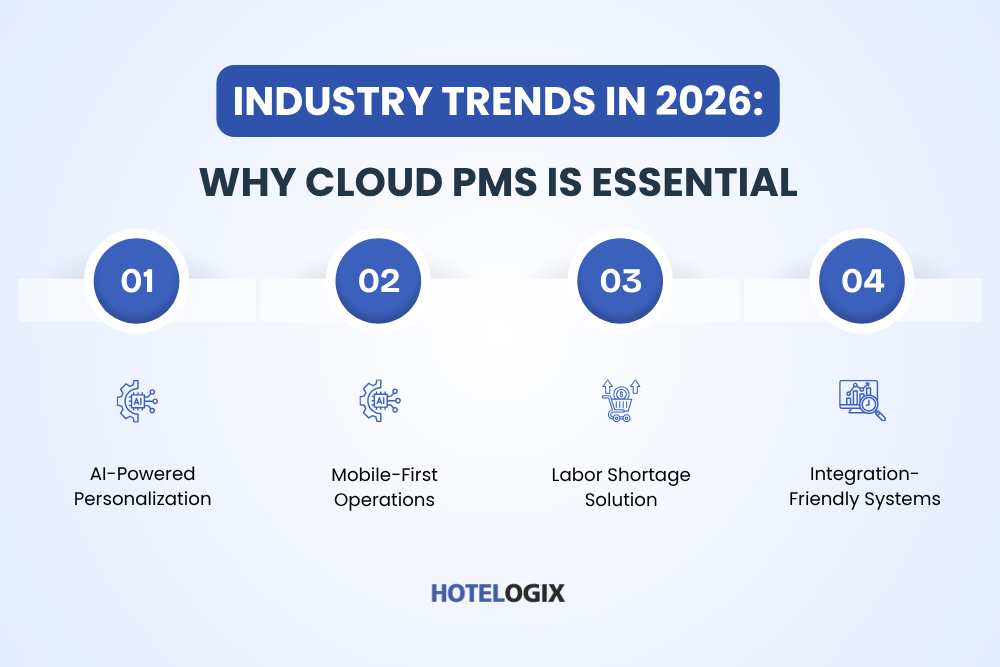
- AI-Powered Personalization: PMS platforms can suggest upgrades like spa packages or late check-outs based on guest history .
- Mobile-First Operations: Staff can manage check-ins, housekeeping, and rates from tablets or smartphones, even when away from the front desk .
- Labor Shortage Solution: Automation helps you do more with a smaller team, reducing hiring costs without affecting service quality .
- Integration-Friendly Systems: Your PMS can connect with POS, CRM, accounting software, and marketing tools to give you a full view of hotel performance .
Product Focus: Multi-Property & CRS by Hotelogix
Guest profiles are stored centrally, so a loyal guest who stayed at one location can receive the same personalized service at another. This saves staff from re-entering data, reduces errors, and ensures a consistent brand experience across properties.
Example: A hotel group using Hotelogix reported saving 20+ staff hours weekly by managing all properties through a centralized CRS
Request a Free Trial and see how Multi-Property & CRS can make operations smoother and faster.
Key Takeaways for Hoteliers
A PMS is your hotel’s digital manager. It saves time, avoids mistakes, improves team coordination, and creates a better guest experience. Choosing a modern, cloud-based PMS like Hotelogix ensures your hotel stays competitive, runs efficiently, and is ready for future growth .