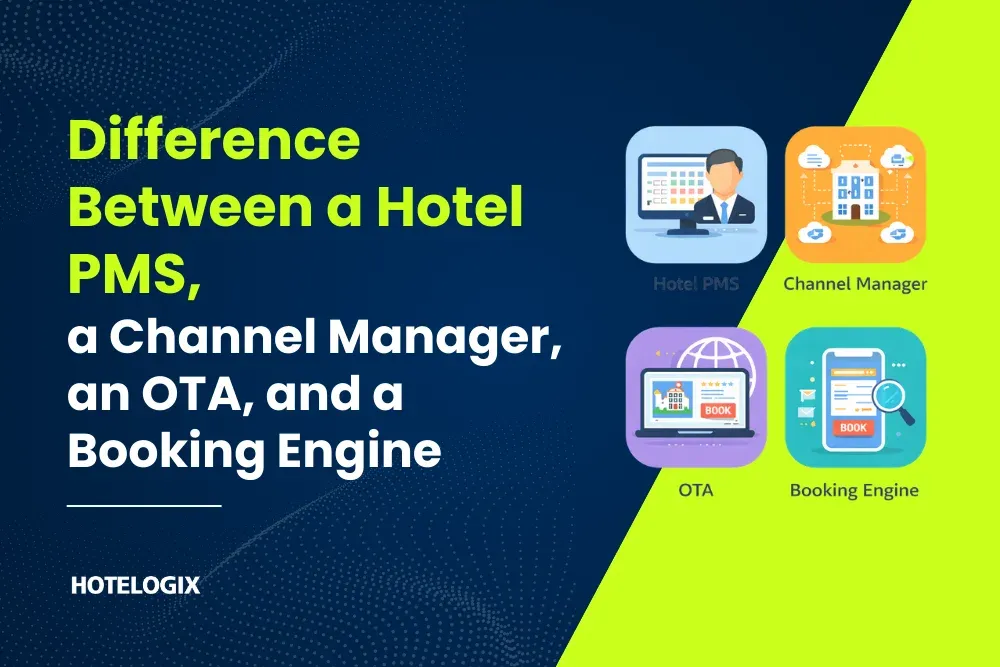
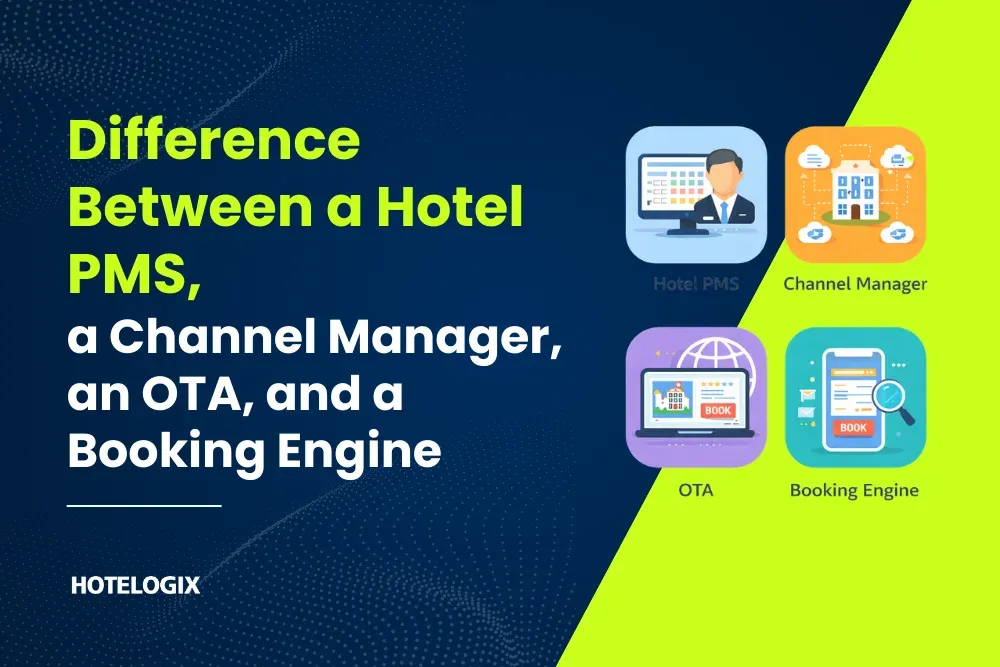

Running a hotel becomes much simpler when you understand what each system in your tech structure actually does. But with terms like PMS, channel manager, OTA, and booking engine used interchangeably, it’s easy to mix them up.
In this guide, we’ll break down the difference between each tool in simple, hotel-friendly language, so you can decide what your property really needs and how these systems work together to make your operations smoother.
Key Takeaways
- Save hours on reports: Cloud hotel accounting tools turn long manual reports into quick, automated summaries your team can finish in a fraction of the time.
- Fewer mistakes, smoother audits: Automated reconciliations and live financial data reduce human errors and prevent mismatched entries.
- One dashboard for all properties: View financial performance across multiple hotels, outlets, and departments without switching systems.
- Smarter financial decisions: AI-led forecasts and easy-to-read reports help you plan costs, control expenses, and improve profitability.
What Is a Hotel PMS?
A Property Management System (PMS) is the core software that manages everyday hotel operations. It replaces manual registers, spreadsheets, and disconnected tools with a single dashboard.
A PMS typically handles:
- Reservations and room allocation
- Check-in and check-out
- Housekeeping coordination
- Billing, folios, and POS postings
- Reports and revenue insights
- Guest profiles and communication
Think of your PMS as your hotel’s control room. Everything starts here.
Understanding PMSI & Types of PMS
What is PMSI?
PMSI stands for PMS Interface. It connects your PMS with external systems like channel managers, payment gateways, door locks, accounting tools, POS, and more. Without proper PMSI, hotels face data mismatches, manual errors, and syncing delays.
Types of PMS
Hotels today choose between:
- On-premise PMS
- Installed locally on computers or servers
- Requires IT support and maintenance
- Cloud-based PMS (now the industry standard)
- Runs online
- Accessible anytime
- Easier integrations & automatic updates
Cloud PMS systems like Hotelogix are popular because they support multi-device access, quicker integrations, and faster implementation.
What Is a Channel Manager?
A channel manager connects your hotel to OTAs and keeps your inventory and rate updates consistent everywhere.
A Channel Manager helps you:
- Update room rates across all OTAs instantly
- Prevent double bookings
- Reduces manual work by automating the process
- Sync promotions or rate plans across platforms
- Increase visibility by connecting to more OTAs
It’s the only practical way to manage distribution without spending hours on manual updates.
PMS vs Channel Manager: Quick Comparison
Here’s a simple table to help you see the difference clearly:
What Are OTAs?
Online Travel Agencies (OTAs), such as Booking.com, Expedia, MakeMyTrip, and Agoda, are online platforms where travelers search, compare, and book hotels.
Why hotels use OTAs:
- Huge global visibility
- Access to new markets
- Credibility for small or independent hotels
- High marketing power
But they come with:
- Commission fees (15–25%)
- Limited control over guest data
- Heavy competition for listings
OTAs are essential—but relying only on them can become expensive and impact profitability.
What Is a Booking Engine?
A hotel booking engine is the tool that lets guests book directly from your website or social channels, without having to pay any commissions.
A Booking Engine helps you:
- Drive more commission-free bookings
- Offer special rates or packages
- Get instant confirmations
- Accept secure online payments
- Reduce dependency on OTAs
- Improve guest trust in your hotel website
It’s one of the easiest ways to increase revenue without raising prices and also helps in building guest loyalty.
OTA vs Booking Engine: Quick Comparison
How These Systems Work Together
Here’s how a modern hotel’s tech stack flows:
- PMS manages room operations.
- Booking Engine captures website bookings and sends them to PMS.
- OTA Booking comes through a Channel Manager, which syncs everything with PMS.
- The PMS updates availability, which goes back to the channel manager and booking engine.
This closed loop ensures:
- No double bookings
- Real-time updates
- Less manual work
- Higher accuracy
- More direct bookings
When everything talks to each other, your hotel runs smoothly.
How Hotelogix Brings It All Together
Without sounding technical or overwhelming, Hotelogix helps you:
- Manage your daily operations from a single dashboard
- Sync inventory and rates across OTAs in real time
- Capture more direct bookings through your website
- Reduce errors and manual updates
- Make decisions based on smart, easy-to-understand reports
It’s built to help small and mid-sized hotels save time and improve guest experience—without needing a large team or IT expert.
FAQs
Q1-Do small hotels really need both a PMS and a channel manager?
A-Yes. A PMS handles your internal operations, while a channel manager looks after your online sales. They do completely different jobs but work best when connected.
Q2-Is a booking engine the same as an OTA?
A-No. OTAs bring visibility, but they charge commissions. A booking engine is your hotel’s own direct booking tool, where you keep 100% of the revenue.
Q3-Can I run a hotel with only a PMS?
A-You can, but you may face double bookings and miss out on real-time OTA updates. A PMS works best when paired with a channel manager and booking engine.
Q4- How does a channel manager prevent overbooking?
A-It automatically updates your room availability on all OTAs the moment a booking is made anywhere, thus helping you prevent overbooking.
Q5-Do these systems integrate easily?
A-Hotelogix integrates seamlessly with channel managers, booking engines, POS systems, payment gateways, and more—so everything stays in sync.
Q6-What is the biggest advantage of connecting all systems?
A-Real-time accuracy. Every booking, rate update, and room status change flows automatically across all platforms.
Q7-Does Hotelogix integrate with major OTAs?
A-Yes. Hotelogix integrates with Booking.com, Agoda, Expedia, Airbnb, and many others through its channel manager.
Conclusion
Hotel technology doesn’t have to feel complicated. Once you understand the role of each system—PMS, channel manager, OTA, and booking engine—it becomes much easier to decide what your hotel needs.
When these tools work together, your operations become smoother, your distribution becomes stronger, and your guests enjoy a better experience. If you want all of this in one place, Hotelogix makes it simple to manage your hotel without stress—so you can focus on what truly matters: your guests.
Curious how this works for your property? Schedule a quick demo with us.