
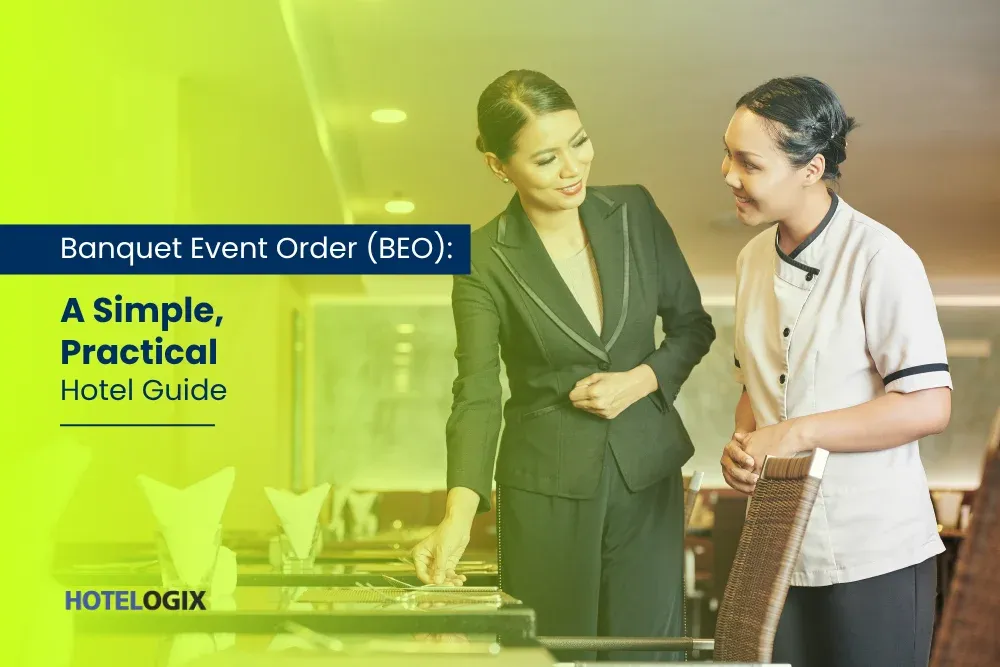
Events go off the rails when teams don’t share the same plan. A Banquet Event Order fixes that. It’s the one document that tells every department what’s happening, when, where, and who’s responsible—so setup, menu, timing, and payment details don’t get lost.
Below is a clear, human-first guide to what a BEO is, why it matters, how to manage updates, and how Hotelogix Cloud PMS can make the whole process easier.
Key takeaways
- Clear coordination: Sales, kitchen, banquet, front desk, housekeeping—everyone follows the same playbook.
- Legal protection: Once signed, the BEO becomes the binding agreement for services, payments, and cancellations.
- Complete clarity: Setup, catering, staffing, logistics, and pricing live in one document.
- Fewer errors: Version control and simple communication prevent missed updates.
- Accountability: The BEO shows who does what and by when.
- Better guest experience: Smooth execution reflects well on your hotel.
What is a Banquet Event Order (BEO)?
A BEO is the working blueprint for an event. It lists the logistics (room, layout, AV), service details (menu and timing), staffing, and billing, so every department knows its part. It also plays well with core hotel systems—your Central reservation office for room blocks, GDS connect for corporate bookings, and your Web booking engine if guests need to book rooms tied to the event.
You may also hear Catering Event Order (CEO). The difference is small but useful: a CEO focuses on food and beverage; a BEO covers the whole event—setup through guest flow. In short, the BEO keeps the client’s expectations and your hotel’s execution aligned.
Why is a BEO essential for hotels?
Hotels juggle weddings, conferences, parties, and meetings—often on the same day. Without a solid BEO, small gaps turn into big problems. A good BEO delivers:
- Clarity & coordination: One source of truth.
- Accountability: Tasks are assigned, not assumed.
- Efficiency: Fewer last-minute surprises.
- Guest satisfaction: You deliver what was sold at booking.
BEOs as legal contracts
Once signed by the client and your hotel, the BEO is a legally binding document. It should clearly outline:
- Services and inclusions
- Payment terms and deposit schedule
- Cancellation or refund policy
- Responsibilities and service expectations
This protects both the hotel and the client and reduces dispute risk.
Key components of a BEO
Put every operational detail in one place. Use this as your baseline:
Tip: Keep layout thumbnails and menu versions attached. It speeds up reviews and avoids “which file is final?” confusion.
Managing BEO revisions and updates
Changes will happen—guest counts shift, menus tweak, timing moves. Keep updates simple and visible:
- Version control: Put a clear version number and timestamp on every update.
- Immediate redistribution: Share the latest file with kitchen, banquet, front office, housekeeping, and accounts.
- Digital documentation: Store all versions in a single, named folder so anyone can trace decisions.
- Secure storage: Keep signed copies in a controlled, backed-up location.
- Confirm receipt: Ask each team to acknowledge the latest version before moving forward.
This keeps everyone on the same page and avoids surprises on the event day.
Training your team on BEO management
A strong BEO only works if teams know how to use it. Make training simple and routine:
- Read and understand every section before prep starts.
- Follow the timeline exactly (setup, service, strike).
- Review room layouts and AV placement on a quick walk-through.
- Route updates through one point of contact to avoid mixed messages.
- Handle last-minute changes without disrupting agreed flow.
Short post-event huddles help you find gaps and improve the next BEO.
Payment terms, deposits, and cancellation policies
Money conversations go smoother when terms are clear in writing. Your BEO should include:
- Deposit details: % required to confirm the booking.
- Payment milestones: Due dates and accepted methods.
- Cancellation policy: Cut-off dates and penalty percentages.
- Refund procedure: Timeline and approval authority.
If your event includes room blocks, note where guests will book (e.g., your Web booking engine) so finance and reservations track deposits and cut-off dates in the same place.
Common BEO mistakes to avoid
Even experienced teams miss things under pressure. Watch for:
- Ensure both the client and the hotel sign the BEO; do not allow the event to proceed without the required signatures.
- Record every dietary restriction and special request, and share them with all relevant teams so nothing is missed in service.
- Verify the event timeline to prevent incorrect timing and avoid overlaps with other scheduled functions.
- Confirm that every department is working from the latest BEO version, and retire older versions so conflicting instructions do not circulate.
- Prepare a contingency plan for weather and audio-visual (AV) issues, including backup equipment and an alternate setup if conditions change.
A 10-minute cross-check before final sign-off is cheap insurance.
Simplifying BEO management with Hotelogix
Why Hotelogix works well here (and why it shows up on shortlists for the best hotel management software and the best hotel management system):
- Centralized coordination: Menus, guest lists, room blocks, and billing in one system.
- Real-time updates: Changes appear for all departments as soon as you save.
- Multi-property support: Ideal for groups and banquet venues, with Multi property & CRS views.
- Automated reporting: Track event revenue, costs, and occupancy with less manual work.
- Mobile access: Review and act on BEOs on the go.
- Plays nicely with revenue ops: If you use a Revenue management system, keep event demand and room blocks visible for better rate decisions.
When you evaluate platforms, look at how top hotel management software handles events, reporting, and cross-team workflows—and whether it’s regarded as the best software for hotel management in your segment.
FAQs
Q1-Who signs the BEO?
A-Both the client and your hotel’s authorized signatory—this confirms shared understanding of all details.
Q2-When should the BEO be finalized?
A- Aim for 3–7 days before the event. That gives each team enough prep time.
Q3-What if changes occur after signing?
A-Create a revised version, mark the date and version number, and redistribute to all departments.
Q4- Can BEOs be used for outdoor events?
A-Yes. Add setup logistics, weather contingency, power/source plans, and pathway access for vendors.
Final takeaway
A BEO is more than paperwork—it’s the operational heart of a successful event. It keeps teams aligned, reduces risk, and improves guest satisfaction. With Hotelogix Cloud PMS, you can create BEOs faster, push updates in real time, and execute with confidence—every single time. If you’re shortlisting tools, check where Hotelogix appears among the best hotel management systems and top hotel management software for events and banquet workflows.
Ready to simplify event ops and deliver smoother functions? Book a demo with Hotelogix.